The Flâneuse and I
The Flâneuse and I
I Walk, Therefore I Become
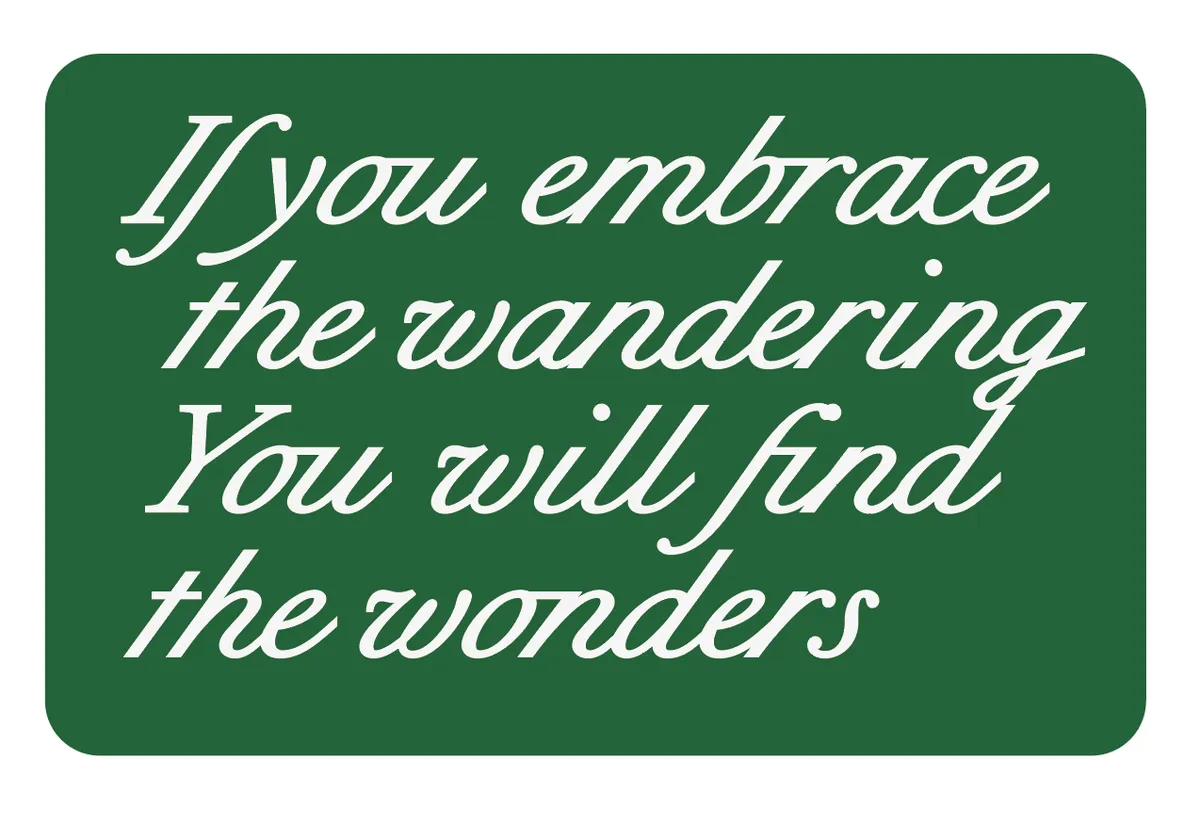
It may not look like much, not with all these other distractions, but we make things holy by the kind of attention we give them.
— Martin Shaw, Smoke Hole: Looking to the Wild in the Time of the Spyglass
When I met a friend of mine some months ago, we got to talking about Sex and the City. She confided that upon rewatching the show as an adult, she noticed Carrie wasn’t very likeable, possibly a bad friend, and an altogether problematic person. I agreed at the time. It turns out we’re not a minority, at least not on the internet: Carrie seems so disliked online that Broey Deschanel made an excellent video essay on her character and argued that some of that hatred for Ms Bradshaw reveals misplaced misgivings about what a female character is supposed to be like. This isn’t meant to be a deep dive into Carrie Bradshaw — Maia does that already in the video essay.
SATC isn’t a massive touchstone for me. I missed its heyday and only really came to it in adolescence and adulthood. I remember watching it with my mom for the first time when I was about to graduate from high school and now intermittently watch it with my partner. We enjoy the fashion as much as we like to discuss the behaviors and the relationships on display. This, to me, is the clearest testament to the show’s impact and relevance: it still sparks conversations about romance, sex, and friendship. While the setting of SATC is far from relatable, these themes undoubtedly are. When I see Carrie’s arc(s) with Mr Big in particular, I’m in disbelief over how familiar the issues plagueing heterosexual relationships are that are presented within their ill-fated entanglement. Some of them have popped up beat by beat in my own love life. Turn of the century’s Mr Big is five years ago’s fuckboy is today’s creative director aspirant trying to make his pant legs look wider for a fit pic.
In the video essay, Maia designates the city as fifth main cast member and characterizes Carrie as a flâneuse of New York. I was instantly fascinated by that characterization. It’s nothing new that Carrie’s life in particular is aspirational and unrelatable to an almost absurd degree. She has a gorgeous, rent-controlled apartment in a vibrant metropolis. She not only writes columns for a living, she is seemingly paid exorbitantly for them and snags a book deal off of them. Throughout, she has the means to regularly shop and wear luxury designer pieces, regardless of how broke this habit leaves her. Most of us don’t even have the initial capital necessary to let designer purchases break our bank. Carrie also has three amazing friends who not only care deeply for her, but also consistently inspire her writing.
That she is a flâneuse might not stand out amongst these privileges, but it resonated with me. My younger self yearned for few things as much as it yearned to walk around and experience a city like New York, a far cry from the picturesque paradise of mountains and lakes I grew up in. I recalled the city trips I’d taken in the past and how walking and exploring was, in hindsight, most precious to me. All the other joyful things, looking at and touching beautiful objects, learning about a city, eating food — they flowed from walking. I was a flâneuse!
⁂
In the Oxford English Dictionary, a flâneur is defined as ‘a man who saunters around observing society’.
I walk slowly, which others walking with me have bemoaned on multiple occasions, so technically, I saunter. I‘m observant to the point of being nosy, sometimes stopping in my tracks and looking at a situation unfolding, whether or not it has anything to do with me. I always maintain that it might. This, too, others have bemoaned. I live in a society. I am, however, not a man. The flâneur is a creature of his time (and of a specific place, Paris): a 19th Century literary figure, he is a man about town. He was in part born thanks to quickening urbanization and the growing allure of the city and, crucially, wasn’t subject to misogynist stereotypes and accompanying violence, which literally stalked women in public spaces and continue to stalk them nowadays, albeit in different disguises. The concept of the flâneur is definitionally gendered, because sauntering (in the city) has been a gendered act.
Women didn’t shun the public sphere in 19th Century Europe, though, nor in many other places in the world, I’d wager. First of all, many of them likely didn’t have a choice, since wage and reproductive labor required them to venture outside. Trying to learn a bit more about what it was like for women to be out and about, I stumbled upon an archived BBC piece on Women and Urban Life in Victorian Britain by Lynda Nead and lo and behold: Victorian middle and upper class women were walking and taking means of transport independently. Nead emphasizes this due to contemporary misconceptions that women were absent from cityscapes. It’s easy to see from where these misconceptions came given the views on women in urban space that circulated at the time:
Respectable women, it was claimed, could not be part of the public sphere of city life. If women left the safety of the home and were on the streets, it was claimed, they became corrupted by the transgressive values of the city. They would be thought to be either prostitutes or vulnerable working women - with both groups the victims of a hostile and threatening environment.
The enduring hold such views have on us is maybe clearest when it’s dark. In a German book revolving around space, power, and gender in the context of feeling (un)safe of which I read excerpts for a Gender Studies class, the author Renate Ruhne identifies a paradox: in surveys from the 2000s, women consistently answer that they feel unsafe in public spaces after dark, even though they are much likelier to experience violence in private spaces (and at the hands of people they know) than in public. Ruhne argues this persistent feeling of being unsafe arises because women project the violence and power imbalance in societal gender relations between women and men onto the built environment. A key takeaway from Ruhne’s book is that we can’t generate safety purely through material ‘improvements’ like brighter lights or women-only subway cars, but that safety as a feeling is tied to gender equality and its lack is a reflection of inequality.
The gender stereotypes at work here are numerous. Women belong in the domestic sphere and outside of it become prey, men are their predators. Women are always on the defensive, men on the offensive. Women are in need of protection, violent men (bad apples) need to be reined in, ideally by good men (the norm) who act as chauvinist protectors. Returning to Nead’s quote above: When women walk in certain ways and in certain areas, they are corrupted and possibly morally bad (often: loose), hence it’s okay to attack them.
These stereotypes and the dynamics they produce are maybe most evident in how society views sex workers, enacts violence upon them, and legitimizes it. Historically, female sex workers were walking the streets, day or night. As Nead described, beginning in 18th Century Britain, a woman out and about in unsanctioned ways might even automatically assumed to be a sex worker. This, again, was even truer at night: In an interview on his book Nightwalking, Matthew Beaumont states how women in Britain at that time did not have a right to the city at night. The strongly negative view of the profession coupled with the geography of her work makes the sex worker especially vulnerable to violence, with the former reducing empathy for when she’s harmed and the latter spatially separating her from areas where harm deserves our empathy, sincere mitigation, and prevention.
In the abstract of an article from 1989 titled The geography of women’s fear, Gill Valentine puts it succinctly: “(…) women’s inhibited use of space is a spatial expression of patriarchy.” The perfidious implication of what Ruhne and Valentine argue is that part of this spatial manifestation of patriarchy is sustained by women expecting to be attacked in public and altering their behavior. In a way, that means we operate within or at least surrender to this intersection of space and patriarchy. I don’t write this with judgment. Defiance often attracts negative attention and I, too, would rather make myself smaller when someone manspreads next to me in public. I, too, will sometimes change out of a revealing outfit because I basically fear people will think I’m a whore. This is what the threat of patriarchal violence and internalized patriarchal ideas will do to you, self-diminishment and distancing yourself from other women in an attempt to save your hide.
⁂
The ease with which the women in SATC navigate the city strikes me as wish fulfillment. Returning to my examples above, they are unafraid to take up space. Samantha dresses revealingly and is openly sexual in all contexts, in fact, her behavior often crosses lines and veers into the toxically masculine. The show universe refuses to punish them for it. At one point Carrie gets robbed, but afterwards she doesn’t as much suffer from fear of being physically harmed, as she suffers emotionally from the theft of her Fendi Baguette. Let’s be honest, who would mind living in a world where that was top of the mind after having been robbed? This complicates Carrie’s taking on the role of a flâneuse.
Can the flâneuse even exist outside of fiction, given how interlocked public space and patriarchy have historically been and remain to this day? As is often the case, it depends on who you ask. In the video essay, a Guardian article on the flâneuse by Lauren Elkin is briefly referenced. Elkin has written a book recounting her own experience with sauntering and spotlighting flâneuses, literary and real, along with their thoughts on walking the city. In the article, Elkin defines the flâneuse in the following terms:
For a woman to be a flâneuse, first and foremost, she’s got to be a walker – someone who gets to know the city by wandering its streets, investigating its dark corners, peering behind façades, penetrating into secret courtyards.
So far a familiar definition. In addition, she stipulates that in contrast to the flâneur, the flâneuse is defined by the very act of going places she shouldn’t go according to the sensibilities du jour. Her definition weaves the fraughtness of women’s presence in public in and acknowledges the gendered nature of the original literary figure. Echoing sentiments in Nead’s piece, Elkin insists that despite it all
(…) there have always been women writing about cities, chronicling their lives, telling stories, taking pictures, making films, engaging with the city any way they can (…). To suggest that there could be no flâneuse because she wasn’t literally a female flâneur is to limit the ways women have interacted with the city to the ways men have interacted with the city. Perhaps the answer is not to attempt to make a woman fit a masculine concept, but to redefine the concept itself.
At first, I thought a flâneuse was obviously a woman flâneur. Whether a woman could join the ranks would then depend on whether she possessed the usual markers that act as a buffer between her mind and body and the onslaught of societal hierarchies and their ills. Carrie, Charlotte, Miranda, and Samantha are upper middle class to wealthy. They have stable jobs, pretty intact mental health, and a supportive community, even beyond their immediate friend group of four. They’re gorgeous white women in a city in a country that’s (still) racist. There’s nary a place where they aren’t supposed to go and might be punished for going. That would be measuring them up against the masculine ideal.
Elkin intends her to be emancipatory in a different way, locating her appeal in being a woman who goes places in defiance of patriarchal norms that limit her freedom of movement and exploring spirit. This is what motivates the book. When the four leading ladies of SATC commit transgressions, they are on the whole relatively minor. But being a flâneuse per Elkin is an accessible role in that focusing on relative transgressions makes it open to all women, yet capable of containing every woman’s unique struggles. Carrie‘s upper-class flâneuring will look markedly different from that of a fictional character who works as a maid, but both can engage in it.
So, Elkin’s definition is more inclusive. At the same time, I think her conception risks being gender-essentialist. It expands the vocabulary and adds women’s experiences, but it doesn’t actually de-gender the concept of sauntering and observing. It also puts forward a paradox: given a commitment to equality, the flâneuse must function as a means to an end. In the Guardian article, Elkin proclaims “To up and go is the boldest statement of self-preservation. Laying claim to flânerie has always enabled women to reroute the paths they were expected to take, and disrupt the lives they were expected to live.” Maybe then Elkin would agree that a flâneuse’s uninhibited use of space is an ongoing walk towards equality. If the role of the flâneuse exists in relation to a patriarchal context and in the service of thwarting that context, it ceases existing in a gender-equal one. For the role to be truly emancipatory, then, it must be interested in at some point not being noteworthy anymore. As I was writing this piece, Rayne Fisher-Quann summarized the general logic of what I’m trying to say here with a note on “under communism you will be like other girls”.
⁂
When exploring a city in Switzerland, I’m not physically prevented from going anywhere due to prejudices against my gender. Every so often, I feel conspicuous and like I don’t belong, though. It happens in stores with fancy clothing, where I’m never sure why store clerks ignore me, until I realize I’m bare-faced and don’t look rich. It happens when people remark how amazing or adorable my Swiss dialect is (I’ve lived in Switzerland practically my whole life). As a result, I dread awkward situations in which people might unthinkingly react to single or compounded facets of who I am. Harking back to Ruhne’s theory, just as women’s unease in public spaces at night is tied to sexism, my unease in public is tied to racial and class discrimination I know of and have experienced myself.
While none of this bars me from going anywhere, being othered is disruptive. It makes me self-conscious and that’s not a place from which I can easily and freely observe the world. It’s a pity since what I adore most about the concept of the flâneuring is the element of observation. Observing is a beautiful act. Things become precious when we pay attention to them, which means observing also creates. In turn, paying attention is how we express something is precious to us. It might seem passive, but I like to think of it the observing gaze as actively looking for connection, something to attach itself to. Elkin writes “As we progress through the cityscape there comes a point when we are no longer just reacting: we are interacting, created by this interaction.” And who‘s to say that through being changed by what we observe, the object of our attention hasn‘t itself changed as well? I guess that’s what I tried to express in a previous post — traveling can be a form of becoming, and so can the act of walking and looking intently, no matter where we go.
Ultimately, I’m not as interested in doing something transgressive as I’m interested in the sauntering, observing, investigating, peering, and penetrating. I don’t generally want to chafe against unfair barriers and I don’t enjoy confronting people who unduly discriminate — I want the barriers and discrimination gone. I think the beauty of flâneuring, the reason I’m drawn to and identify with it, lies not in how subversive it might be, at heart a relative characteristic. Instead, it lies in the absolute ideal it proposes of moving in the world in a leisurely manner, seeing it deeply, and making yourself and the world anew through it. That absolute ideal itself is subversive, in a very specific way. As such, the chafing and confronting are mere stepping stones, I accept them only in return for one day being free, in return for winning.
Now I haven’t read Elkin’s book, so I’m in no place to say the subversive potential is what she emphasizes or for what she most celebrates the flâneuring women. In a review, Lara Feigel, someone who has read the book (I assume), argues that it presents women walking almost as an ethic. Feigel notes how Elkin reveres flâneuses state of continuous becoming through their embrace of rootlessness and the being-in-between, in the spatial and abstract sense. In this vein, Feigel quotes Elkin cautioning “Beware of roots. Beware purity”. It’s a concise retort to patriarchal ideas of where (and to whom) women belong and of female respectability. But does that retort not ring true for many? When I read this quote and Feigel’s interpretation, I see glimpses of an ethic not just for women, but an ethic for all humans walking aimlessly, but intently.
Feigel writes as much when she concludes her review:
The individual can live more honestly when she allows life to be experienced as a process rather than a series of goals to be worked towards. At the same time, collectively, we can create a more hospitable world when we allow the possibility of wandering to challenge the fixed borders of the nation state.
Amidst a right-wing political turn towards racist borders, securitizing the Other, and controlling difference, Feigel’s strikes me as a poignant reading of the flâneuse. It also dislodges her from standing only in opposition to the flâneur and urban manifestations of patriarchy. Flâneuring conceivably puts you in opposition to so much: urban architecture inhibiting life rather than nurturing it, alienation, erosion of accessible public space, destruction of anything non-human that isn’t technology or infrastructure. All combining into a hostile urban vibe (for lack of a better word at this stage) that encourages you to remain domestic, isolated, and lonely, incidentally the perfect state for endless scrolling.
Feigel’s reading embeds the figure of the flâneuse within a diverse group of people who resist being fixed in one place, told to never wander without a purpose, with ‘I enjoy wandering’ not deemed purpose enough. People who as a result are effectively robbed of encountering, observing, becoming — robbed of accessing crucial aspects of subjectivity. What makes her inspirational, then, is not that she is a subversive woman, but that she, too, attempts to break free. A life like Martha Gellhorn’s deserves to be recognized in its minutiae, in all its individuality and particularity. Then, it deserves to be placed within a long and large tradition of seeking the freedom to be in flux, to encounter the world and change both it and yourself, in all that freedom’s universal appeal.
⁂
The longer I wrote and thought about it, the less sure I was that either Carrie Bradshaw or I were flâneuses. I now think she’s actually close to shedding the role. Her sovereign way of being and carrying herself in the city isn’t ever really considered special, out of the ordinary, or subversive within the show’s world. Come to think of it, she doesn’t so much explore New York than live fully in it. She has the right to the city. New York is her oyster and that is inflected in her larger character arc. Throughout the show, Carrie undergoes significant changes. She decides to get married, then decides not to, and decides to again. She gets a book deal and becomes more of an institutionally recognized writer.
No one pressured her into wanting marriage. The book deal was offered to her, she wasn’t compelled to take it or pursue it because she needs the money or craves acknowledgment that her career writing about sex and relationships is serious. By and large, Carrie does things because she wants to. The video essay that prompted me to write this asks in the title ‘Who is afraid of Carrie Bradshaw?’. Who is afraid of a little wish fulfilment? What does it say if our relationship to utopia, to ‘having it all’, is often marked fear, scoffing, and cynical rejection? I get that shows like SATC shouldn’t induce escapism, shouldn’t be a cloak thrown over reality. But it can clarify a vision, make us understand what isn’t ours yet and how much we want to close the gap.
Looking at Carrie, her relationship with the city, her freedom to choose, to change, and be changed by the city, I can’t help but think: this is kind of it.
That’s what flâneuring can win us.
⁂