How Do You Live?
How Do You Live?
My very own animist turn.
I created a companion channel on Are.na for this piece, head over there to see quotes, pictures, and sundry other things I felt are related to loving pigeons, resonance with animals, the more-than-human, the enchanted mood, and being at stake to each other. As always, thank you for reading <3
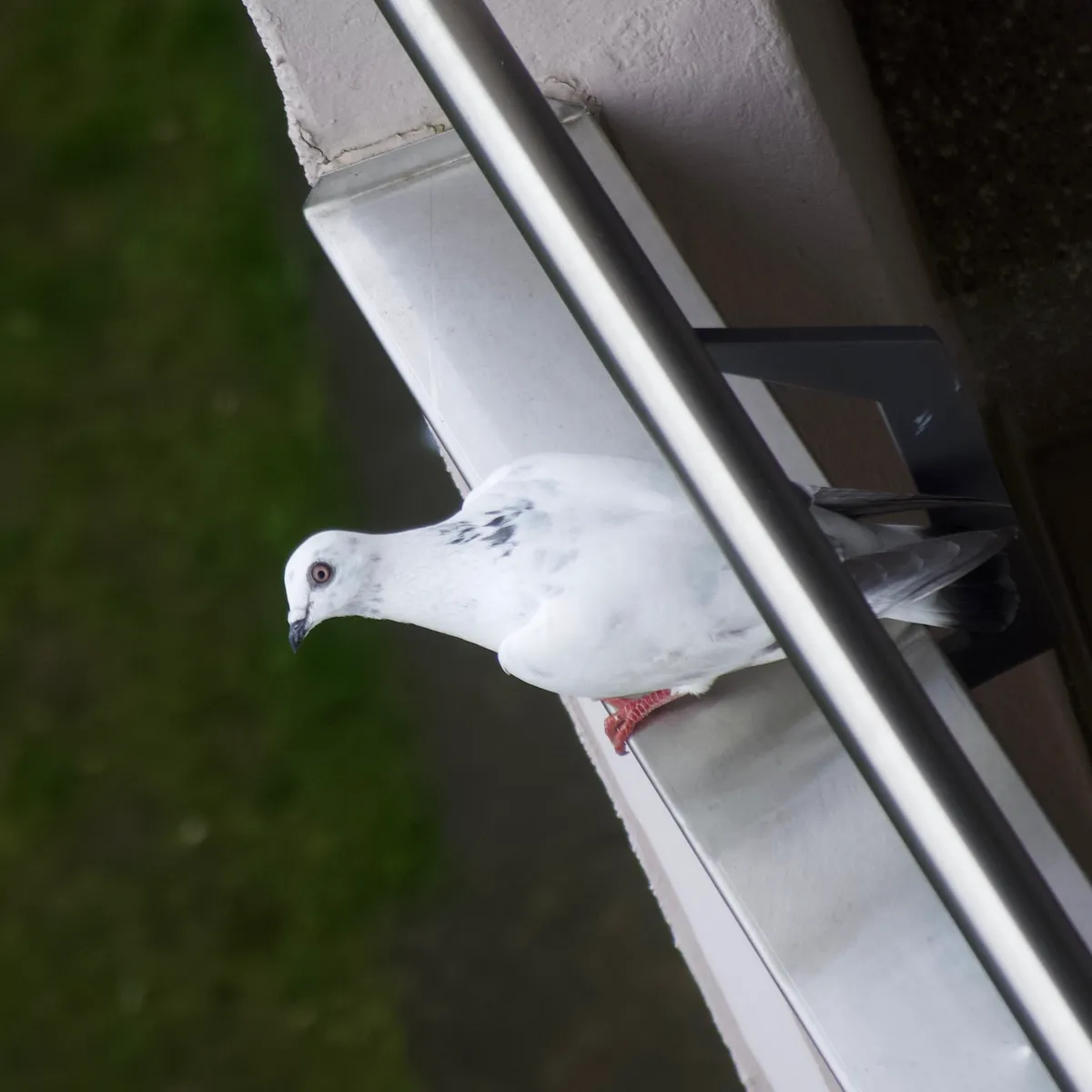
One evening in May, as my partner and I were coming home, we found a small white pigeon huddled at the edge of a step on the staircase leading up to our apartment. It was a windy and chilly week and the pigeon looked very cold, all puffed up, barely moving. I feel like I don’t need to spell this out, but normally, pigeons fly away when your foot is close to accidentally kicking them off a step’s edge. Penelope/Houdini/Dina, as she came to be known among us, didn’t budge. Along with the toxic green poop she had made and would continue to produce during the night, there were many signs that she needed help. Where had she come from? Who was she? What did she need? These questions were on our mind and we couldn’t just leave her to fend for herself.
Over the next few days we would fail over and over to catch her, unable to grab her decisively, to throw towels on her on time, to have the box trap we prepared ensnare her at the right time or even stay in place. We made the well-intentioned miscalculation of first feeding her to decent health, which meant that she started evading our entrapment attempts by flying, even going so far as to immediately flee when I approached. But she wouldn’t leave either, since our outside staircase was now where she knew she would get food. I was grateful there was a local wildlife rescue organization I was able to get in touch with and get help from; they originally sent me a hilarious drawing of aforementioned box trap which eventually did the trick. However, after my partner successfully caught her and brought her to a sanctuary aviary by foot (in a small box, her peeking out here and there), being the skinny little thing she was, she escaped the aviary and returned to the corridor leading to our apartment door the next day. I remember on that day him somewhat arbitrarily opening the front door, peering out, then asking me with a mix of incredulity and premonition if I knew who was there. That’s how she received, nay earned, her second name, Houdini. Penelope was her first given name, kindly provided by a friend. Being the maverick she is, having at least two seems befitting.
I don’t know exactly when I began to love pigeons. If I had encountered Houdini 10 years ago, would I have made the same effort? Maybe, like me, you’ve been seeing the memes about getting into ornithology and becoming obsessed with birds once you hit your 30s. Maybe, unlike me, you ignore them and consistently scroll past posts about birds on social media. Posts featuring a Dutch bird-guy asking a bird what to a German ear sounds like whether it has “slept tastily”. Or pigeons photographed from a low angle, looking mighty and chunky. Or an Australian guy traveling the world to see every bird in existence, joyously framing it as a Pokémon-style collection effort. May I suggest you stop scrolling past those beautiful birds, just so you can figure out whether they are actually also one of your passions? It’s okay — you can have as many passions as you want and it doesn’t matter that it seems trendy in one corner of the internet right now. You, too, can become a casual (or not-so-casual) bird lover. The surprising thing about loving birds is that I experience it as largely selfless. I don’t make heart eyes at (feral rock) city pigeons because they’re tasty on my plate, will bring me gifts by stealing from other people, or let me pet them. That being said, I wouldn’t exactly discourage gifts and pets. I simply enjoy that pigeons exist. From relatively afar, I am soothed by the sounds they make when taking flight and by their coos, I like their droll mating twirls and bows, and I am pleased by their feather coats’ beautiful colors and patterns. I wish them the best and I want them to thrive. None of that is the fruit of my love, though, it’s what constitutes it. I found I could feel this way about them, I cultivated it, and I understood it to be love. There is a choice involved: we choose how to encounter other living beings. And I’m not just talking about birds. I am beginning to realize that it’s my task to choose wisely and to choose love whenever possible and for the rest of my life.
⁂
Love can be a hazy and simultaneously slippery word, especially in the English language. It strikes me as so liberally used, so it’s worth being more specific with regard to what loving a bird might mean. Ever since reading German philosopher and sociologist Hartmut Rosa’s Unverfügbarkeit, I conceive of love as a quintessential relation of resonance. Rosa is careful to emphasize in his writing as well as in interviews that his resonance isn’t located on the level of a subject, but a relationship we can enter with something else. A resonant relation in Rosa’s theory has four characteristics: (1) it affects you emotionally, you find something else is ‘speaking’ to you, (2) it features your response to this call, (3) it transforms you and what you’re interacting with, and (4) it’s uncontrollable. Love is all of these things, and more.
Rosa put forward the concept of resonance in earlier work, but it’s connected to the core argument he makes in Unverfügbarkeit: that the world is fundamentally uncontrollable. Despite that or maybe in a foolish attempt to change this fundamental logic, our societies break and bend towards access to and control over more and more. Our economic system and our societies at large rely on ever-increasing control over the world. Control works for some ends, but Rosa believes that the more our hands indiscriminately grab at everything in the world to establish and assert control over it, the further the world retreats, the more silent and dead it becomes. From this clash between fact (uncontrollability) and human hubris (the desire to control more and more), disappointment, alienation, and anger result. Rosa calls this predominant relational mode, this way of being with the world, a relation of aggression, increase, acceleration, and optimization. As a relation of aggression renders the world silent and cold, it‘s antithetical to resonance. Since resonance can neither be forced or planned, nor effectively prohibited, it evades control. Whereas a resonant relationship necessarily leaves open what the outcome might be, aggression has a specific outcome in mind and intends to plow through to it.
Paradoxically, even though resonant relations are inherently uncontrollable, they are often the desired outcome of aggression. That‘s because as Rosa argues, resonance is an intrinsic human desire, even need: we need to be touched, touch in return, and transform ourselves along with the world. This type of relation nurtures us. What Rosa works out in his book is that the way we are going about seeking it is doomed. One example of the doomed dynamic induced by aggressive attempts to resonate, which Rosa returns to a few times, is modern travel, especially the type that aims to bring us closer to nature. Rosa generally views vacations as a major conflict site of a control-addicted society. Safaris, zoos, sanctuaries, nature reserves that invite tourists in — all are artificial sites of nature and set up to promise and induce resonance with nature. In that way, they conceive of resonance as a mere contingency. But as per (4) above, resonance can’t be contingency because it can’t be forced or planned. There’s no resonance automatically resulting from setting in motion a process under the ‘right’ conditions. The world and its phenomena, including resonance, aren’t an intricate machine that can be engineered, assembled to run in predictable ways, and be fixed when it breaks. It’s not even that we just haven’t engineered all the dials or cogs or understood the mechanics of the machine yet — the analogy is false and in this case there is no baby in the bathwater. I’ll return to the role of information and calculability a bit further down.
Rosa writes that travel, vacation, and related spectacles are the market’s attempt to commodify resonance, as an antidote to the daily barrage of tasks and parts of life meant to be conquered and vanquished, brought under our control, lest we fall off and/or into obscurity. As is so often the case, even though we don’t get what we’re sold, it only results in more consumption in a vain attempt to change the outcome instead of questioning the product, the delusion that resonance is the same as contingency and hence fungible. When we look at penguins stuck in a sloppily painted simulacra of their natural habitat and feel as if they might as well be robots, it is mistakenly chalked up to the wrong conditions, to things we can tweak and ‘improve’ until the next time. Maybe the paint is too chipped. Maybe these penguins have odd neuroses or are terribly boring. Maybe at another time of day their sight would change us, with more caffeine in our system. Maybe we were just being weird! What’s easier: fundamentally rethinking an approach to life (aggression, acceleration, accumulation) or using our hard-earned money to simply try again? And what does our culture overwhelmingly suggest we do? Doing the same thing over and over again, but expecting a different outcome — that, as you might be aware, is one of many vulgar definition of insanity.
It‘s tragic a lot of travel sells a promise of resonance with nature, since Rosa cites precisely natural phenomena as absolutely uncontrollable: he starts off the essay with how you can’t force natural snowfall, the kind that awed and delighted you when you were younger, precisely because you were never sure whether and when it would happen. Ecosystems defy aggression and the automaton logic that accompanies it. Thus, when Americans log old-growth forest to feed a hunger for resources, it has ripple effects on the survival of spotted owls and the spread of barred owls in the Northwestern US decades down the line. Or when NatGeo meticulously plans a documentary of Bertie Gregory diving with Great Whites in South Africa, it ends with a last-minute sighting of only one young Great White in waters deemed too risky. If nature was an automaton that simply digested input into predictable output, with however many mediating layers between, it would have no agency. But a resonant relationship requires that other, that something else, to be able to (1) call on us and to (3) transform along with us. Nature’s agency is thus constitutive of its ability to form a resonant relationship with us. Nature must also be a subject.
Even though ecosystems defy aggression, we aggress and find that they can’t defy the consequences. Rosa delineates four strategies with which we commonly try to render things controllable and we dabble in all of them when it comes to flora and fauna: (A) making visible, e.g. by trying to uncover the ‘secrets’ of the deep sea; (B) making reachable/accessible, e.g. by selling diving sessions with orcas in Mexico; © dominating, e.g. by attempting to move lush moss gardens on our private estates indoors and dislocating them utterly; and (D) utilizing and extracting value, e.g. through mass agriculture and livestock farming. It‘s not enough to state that these strategies don‘t work, crucially, they also engender ecological destruction and the creation of wastelands. Bit by bit, in a world marked by aggression, the possibility of resonance recedes from us. Instead, we‘re increasingly met with silence and can only feel sorrow and grief in response. Once again, there is a choice: do we want to encounter the world in an elegiac manner, in mourning, as if everything was already dead? Or do we want to resonate and love? Like when I observe and wonder about a young gull making pitstops on a roof outside my window. Or when I look up during my commute and marvel at a waxing moon against an early evening sky bathed in shades of lilac. Or when I am rushing to my train in summertime and stop to smell my neighbors’ fragrant roses and touch their cooling petals. Or when I meet the big neighborhood ginger cat late at night and cuddle with it. And when the wind blowing over a green field on a sunny day creates ripples resembling ocean waves — glistening, mesmerizing, hinting at something like the sublime. I know my answer.
⁂
How do we know that an encounter with nature is resonant, that nature’s actually transformed, too? Can we know that resonance is real? We can and we can’t. We can because our gaze and our reactions change something outside of us for us, think of ‘to truly see is to love’, and because what we encounter often reacts in palpable ways. But because we are us and not the other, we can never know in a way that translates to a widely cited paper published in a reputable journal or at least a pop science article. Part of that is certainly us falling woefully short of grasping more about our fellow living beings in general. Our control-addled society tries to bring increasing portions of the world under control through gathering knowledge and through science, but we in fact still understand little about other life and the more-than-human world as an extension. Nevertheless, the urge to consume the world and make it accessible without solid scientific knowledge of it or the consequences of our actions progresses. Courtesy of greed, surely, but also an attachment to the master narrative of humans (a narrative that masters us and holds us as masters of the world), containing a commitment to us being special and also the only special ones, somehow chosen.
James Bridle elucidates in his book Ways of Being how the master narrative clouds our view of intelligence in terms of its non-human component and occurrence, with far-reaching implications on our view of non-human agency. Bridle argues that to be intelligent, living beings shouldn’t have to resemble us and that holding prevailing anthropocentric views of intelligence actually masks highly intelligent non-human animal behavior. Constant comparison of non-human animals to us renders them essentially silent and non-agentic, only capable of reacting to stimuli, as a rule. We are becoming more open-minded to exceptions, but the default response is still to shut down as silly and unscientific anything that might dethrone or question the pillars of human intelligence and cognition. Bridle details several examples of intense scrutiny put on scholarly findings of animal intelligence and plant intelligence. When we believe other living beings to be silent by default, when we treat our fellow beings like automatons who necessarily pale in comparison with us, who are endowed with free will and complexity, it’s because we are simply not paying attention. Per the master narrative and our aggressive way of being, we try to grab at animals and fix them in place with scientific inquiry or by stuffing them in zoos and labs, but their secrets elude us, as they should and as they always will. In captivity, they also become neurotic and sad, a self-fulfilling prophecy. Resonance is impossible in a world that is silenced: as Rosa stresses, we can’t resonate with something to whom we ascribe no agency, no capacity to speak to us out of its own accord and in its own voice. Since resonance is an innate human need, all of this ultimately undermines our humanity. It’s shocking how many self-perpetuating ways we have devised to remove the basis for what makes us human, much of it fuelled by the master narrative pretending to honor us by, frankly, (dis)figuring us as complete sociopaths.
Not only do we cover our ears to the song of intelligence, Bridle sees the very thing not residing in beings —as a result of, for example, their brains or other material characteristics —but as residing between us and in the ways we relate to each other. An octopus’ diverse, playful, and alien interactions with its surroundings manifest intelligence. Our ability to build on shared and inherited history and culture to transform and change manifests intelligence. Intelligence is relational. Sound familiar? Anthropocentric views of intelligence limit not only our epistemology, but also our potential for kinship with the world and the ways of being we can adopt. The way of being we exclude yourselves from through anthropocentrism and the master narrative is planetary, enchanted, and mysterious. It begins with crossing the chasm seemingly lying between humans and nature. Bridle joins a minority of voices in questioning why we separate ourselves from what we call ‘nature’ in the first place. Human animals are part and parcel of nature, the earth, this planet. Granted, we possess an ability to analyze not only ourselves, but what’s around us and the concomitant desire to theoretically step outside of ourselves for exactly this analysis and observation. Still, materially, it leaves us inside of our bodies and within nature. Like any analytical separation, the human-nature binary serves scientific purposes we can get behind. But these analytical separations can hardly be summarily accepted as fit for the purpose of informing a blueprint for living life, much of which lies outside of positivist scientific reasoning and outside the institution of science.
So, Bridle tries to inhabit a different perspective by highlighting the view of the more-than-human and using the German term ‘Umwelt’ (often translated as ‘environment’) to focus on interrelations and networks instead of individual units. If we decide to be in our umwelt, to inhabit the more-than-human world, we will first of all find it brims and hums with intelligence and agency. Apart from the octopus mentioned above, Bridle discusses the wood wide web and non-human animal behavior that stirs emotions and imaginations, such as a wild group of primates in a forest observed to look into small pools of water in momentary, complete silence, as if in deep contemplation. When we choose to see ourselves in the midst of others and honor our ties to other living beings, these ties that bind us become conducive to resonance. It can look like making kin with neighborhood birds and getting attuned to their rhythms, their calls, the places they like to hang out, and one day you notice they’ve become a part of what makes you feel at home. It could be banding together with other people to plant native species on a lawn which doesn’t only feed your eyes but also the local critters, providing a lovely resting place when they mistake your flat for their home. It’s looking at where you’re walking so as to not step on snails and safely transport caterpillars from one side of a path to the other when you find them crawling in the middle of it. The different way of being inspired by Bridle’s provocations wards off the aggressive approach to the world that can only diminish it, even if it masquerades as abundance.
Still, there is no way of knowing whether we’re doing any of this absolutely right or whether resonance is real, since we can never fully grasp plants, animals, etc. in their own terms. Our being always mediates and renders elusive the immediate experience of being a dandelion or a caterpillar. Humility is in order. Letting the transformation of the other remain a mystery impossible to predict and comprehend, thereby affording the other subjectivity and agency, is precisely how we make room for resonance, though. This tiny bit of uncertainty and unknowability, once afforded, is re-enchanting. We shouldn’t need to ‘understand’ or ‘make sense’ of animals to love them. We shouldn’t have to conceive of them as intelligent either. If we try to just be with them, to be receptive, and to remain curious as to what might happen — that is the portal that might lead towards resonance and love.
Chasing a narrow conception of knowledge and, through it, establishing control, is a distraction and seldomly yields good outcomes by default. It’s not for lack of knowledge that we persist in a way of being that possibly irrevocably eliminates large swathes of other lifeforms while making them suffer. In the paradigm of aggression, we want to believe that we’re only one discovery and one data point away of solving the world, which is understood as a perennial conflict site. I put to you that knowing has never been enough. If it was, why do we not all put our bodies on the line for the Amazon, commonly called the lungs of our planet, and which is under extractive pressure by people and corporations who will commit murder to protect their extraction? Knowledge is not even nearly sufficient when it comes to figuring out how we should treat each other. If it was, why is Israel still committing what reputable institutions deem a genocide against Palestinians, with scores of countries refusing to do anything meaningful to prevent and stop it? Gathering increasing amounts of information and knowledge is of little use if we don’t grant it the ability to change our way of being, the ability to usher in a transformation towards a resonant way of being and love for life. It’s legitimate to ask what role information might play in such a transformation, but that’s a smaller epistemological question folded into the larger and more important ontological question of what our nature and that of other living beings is, how we can be with them, how we live. As long as we’re busy accumulating information for ends that aren’t transformative, traveling to the ever-receding ends of the world trying to master animals, plants, entire ecosystems, we’re answering these questions in a way that will sooner or later make them moot.
⁂
It feels bittersweet to call for a move towards re-enchantment with what’s outside of ourselves because on approaching the more-than-human, I feel myself pulling away from people and becoming increasingly misanthropic. Maybe two weeks ago I was waiting for a tram and saw a pigeon picking around, walking to and fro on the tracks. The tram approached fast and I felt that the bird needed to start getting out of the way, but it seemed like it wasn’t noticing the approaching danger. The driver actually saw it and rang the bell, but no reaction. With considerable speed, the tram ended up passing over and trapping the pigeon underneath it, in between the rails. I couldn’t help but let out a loud, somewhat panicked gasp. For what felt like the longest time, I waited for what might be left of the bird as the tram was exiting the stop. It had survived, but lost a ton of feathers. I’ve never seen a pigeon situation so reckless and unfortunate. Clearly shellshocked and affected, but luckily not bleeding, the pigeon hopped onto the sidewalk and rested on the stairwell to a store, keeping to the edge of the nearest building on its way there. I’m recounting this because it still makes me angry how nobody seemed to care for this creature. Plenty of people waiting at the stop saw what happened and they must have heard me. Surely, they saw me approaching the bird with a worried expression. I texted my partner about this in the immediate aftermath and later ranted some more about how callous urbanites are towards city pigeons.
In Zurich, the city admin puts up signs saying it’s forbidden to feed pigeons, since they’re wild animals. This is inaccurate: as briefly mentioned above, they’re feral pigeons that are descended from domesticated rock pigeons. Used to living near humans back when we deemed them useful and bred to have a constant reproductive urge, they have settled in cities and somewhat adapted to life there. Starving them as a means of population control might be effective if all you care about is numbers (debatable and questionable priorities), but it’s cruel. So is ignoring them by way of walking straight at them when they’re on the ground, as if they didn’t exist or should suffer us stomping on them simply for existing. I feel compelled to remind people that pigeons are living beings, although no one should have to be reminded of that and it’s largely pointless if the people in question steadfastly believe in a hierarchy of life (and death). Pigeons are also beautiful to look at and don’t do substantial harm. If you go on Wikipedia right now and look at the cited sources for pigeon faeces being corrosive, they’re all “pest control” providers. Actually, you can use healthy pigeon droppings as fertilizer and doing so has a long-ish history. This is the hill I will die on: pigeons deserve love and it is shameful how a large majority of city-dwellers and people in general have let themselves be deluded into hating and abusing them. Not to feel a disconnect with people holding on to such delusions would honestly be more startling.
To be a misanthrope in the face of people who neatly write themselves into the master narrative, however, is a capitulation to it, too. Sure, animals have an easier time pulling me back into the arms of love. As discussed above, they don’t call to or answer me in ways I easily understand, one side effect being that I usually don’t interpret them to be offensive, callous, or downright evil. The debris of human history and all the terrible people I meet, hear, and know, on the other hand, that I just about understand enough for it to cloud my view on us as a whole. But the majority shouldn’t be allowed to damn us all. I think of the helpful and encouraging people working at and volunteering for the wildlife rescue hotline I’ve called multiple times, first to help with Houdini, and a few weeks later to ask what could be done for an injured pigeon I found behind a gas station late at night. I remember the man who runs a local animal rescue and sanctuary and came to pick up Houdini after she’d escaped from his aviary, remarking that she was very pretty (she’s canonically female, but apparently it’s hard to tell with these birds). I think of my loved ones and countless people online, such as the guy who runs nature is not metal on Instagram, who so obviously love, so clearly resonate with what’s out there. We are, overwhelmingly, the aggressors of the world but we are also the people who have a capacity to relate to it differently, to inspire, and to communicate these ways of being to each other.
Come to think of it, love for the more-than-human is more of a fact and less of a choice. I think we have taught, seduced, sometimes forced, ourselves to sever our ties and like forlorn fools are looking for what’s now missing in all the wrong places. The act of severing doesn’t magically stop on the interpersonal level either: we are also alienated from each other, since we are, all the way down, inextricable from the bush, the bug, the breeze. So the real question becomes how we can stop choosing to ignore the ways in which we are, as Donna Haraway puts it, “at stake to each other”. I once kind of disliked pigeons, too. Part of growing up and growing wiser in our age is recognizing and deepening our enmeshment with the creatures that inhabit this place we call home, this planet we call ours. I think the good news is that the call of the more-than-human is just as seductive, if not arguably more, as visions of a frictionless world in glass cities devoid of birdsong and wildness. Keeping our distance takes a toll and feels deeply unnatural, to such an extent that it literally destroys what we view as the natural world. What was pushed away and hidden behind a veil always quickens towards us and sure enough, I think we feel ourselves moving towards it. We should trust that instinct and let the distance decrease — until we are nearly touching the veil, until we open our arms, ready to greet what awaits us once we brush past the porous fabric separating us from each other and the world.
Penelope/Houdini/Dina came back at least once, two or three weeks after she was picked up by our local animal sanctuary guy. She sat in her usual spots on our floor and the one below. She traipsed around the roof of a neighboring building, foraging, something she hadn’t done when we first met her. Her flight seemed much improved. We were delighted and called to her. I waved, speaking the only languages I am proficient in, but I wouldn’t be surprised if she thought I was out to get her again upon seeing my hand moving, towel-holding or not. At one point my partner got out the camera and tried to get a nice shot of her. She was one floor below us, perching, and then looked up:
I hope she’s thriving, wherever she is.
⁂